

Resistance bands sets for beginners: what to check before buying
A beginner resistance bands set is a collection of elastic exercise bands for adding adjustable resistance to your workouts. This 2026 buying guide helps you match band shape, material, and included pieces to your routine rather than choosing by pack size alone.
- Choose a resistance bands set by exercise fit, usable resistance, and material—not the number of pieces.
- Athleticsforhealth suits beginners seeking five portable natural-latex bands for yoga, Pilates, stretching, and strength workouts.
- Check band dimensions and resistance details before buying; thickness alone does not tell you the load.
- Choose handled tubes for grip-based exercises and short loops for movements suited to their shape.
Why resistance bands matter for beginners
Beginners need equipment that is easy to understand, fits their exercise space, and does not require buying accessories before the first workout. Bands offer a portable way to add resistance, but different shapes serve different movements. A set that works for your Pilates routine is not automatically the right choice for standing rows.
For your 2026 shopping shortlist, start with where you will exercise. If you carry equipment between home and the gym, this guide to choosing a waterproof gym bag covers a separate part of that decision: carrying your gear.
The best beginner set is the one whose lightest usable band, shape, and setup match the exercises you actually plan to do. Extra pieces do not fix a poor fit. Neither does an impressive resistance label without an explanation of how it was measured.
How to choose a beginner resistance bands set
1. Match the band shape to your exercises
Write down 3 exercises you want to perform before opening product listings. This is a shopping exercise, not a prescribed workout. Naming the movements makes it easier to spot whether you need a loop, a long band, or a tube with handles.
Short loops are suited to movements that place a band around the legs or arms. Longer bands provide more reach for exercises involving the hands and feet. Handled tubes offer a defined grip, but exercises requiring an anchor also require a suitable attachment and setup.
Do not assume that every product labeled a resistance bands set contains the same equipment. A pack of bands and an accessory kit are different purchases, even when both use the word set.
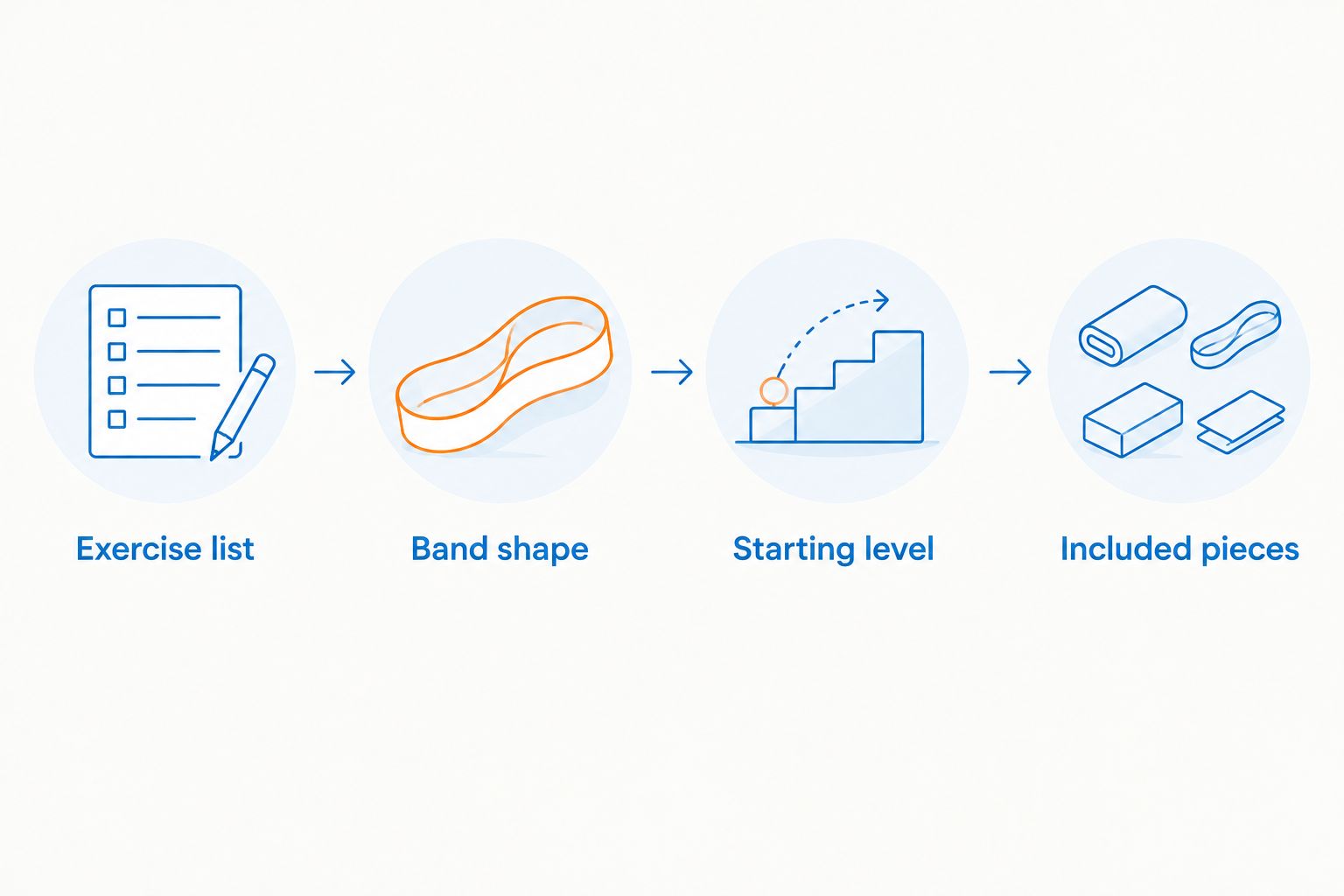
- Exercise list: Name the movements you already know or are learning from an instructor.
- Band shape: Check whether the listing shows short loops, long loops, flat bands, or tubes.
- Grip needs: Decide whether you need handles or can use the band as instructed.
- Anchor needs: Identify any movement that requires an attachment point.
- Included pieces: Separate actual bands from clips, handles, bags, and other accessories.
2. Check resistance information, not just colors
A beginner needs a usable starting resistance, not simply the largest advertised range. Band resistance changes as the material stretches, so a stated load needs context. Read any explanation of the measurement rather than treating a band like a fixed-weight dumbbell.
Colors are useful for telling bands apart within a set. They are not a universal resistance scale across sellers. If you replace a band later, match the documented resistance and dimensions rather than searching for the same color.
Different thicknesses can provide different resistance choices, but thickness alone does not establish a precise load. Choose documented levels over unexplained labels such as light, medium, and heavy. If the listing does not explain the levels, ask before buying instead of filling in the gaps yourself.
- Starting level: Look for a band you can use with a controlled movement and the intended technique.
- Resistance labels: Read the meaning of each level, not just its color.
- Measurement context: Check whether a stated load includes a stretch length or test condition.
- Dimensions: Compare length, width, and thickness where the seller provides them.
- Progression: Look for distinct choices you can move between without changing your exercise setup.
3. Read the material and product details
Material is a buying criterion, not a detail to leave until checkout. Natural latex, other elastic materials, and fabric-covered constructions have different handling and care requirements. If you need to avoid latex, choose a product explicitly identified as latex-free; do not infer that from its color or appearance.
The Resistance Bands Set, 5-Pack lists five portable natural-latex bands for yoga, Pilates, stretching, and strength workouts. Its description also states that the bands have different thicknesses. Those are useful facts for your 2026 shortlist, but they do not establish exact resistance loads, dimensions, or an included anchor system.
Athleticsforhealth's resistance bands set is best for beginners seeking five portable natural-latex bands for varied workouts. Its limitation is equally relevant: the supplied description does not give enough detail to match each band to a precise resistance requirement. Confirm that detail before buying for a specific exercise plan.
- Material: Read the material declaration and any allergy information.
- Band count: Confirm how many bands are included, rather than counting every accessory as a band.
- Dimensions: Request measurements if length or width determines exercise suitability.
- Resistance detail: Ask how the different thicknesses correspond to the listed levels.
- Care instructions: Check cleaning, storage, and inspection guidance for the actual product.
4. Check your space and attachment requirements
Buying bands does not settle the question of where you can use them. Some movements work without an external anchor; others depend on a compatible anchor and an appropriate attachment point. Decide which kind of setup you want before selecting a kit.
For an everyday routine, a no-anchor exercise plan avoids the need to find a suitable door or fixture. That is a setup advantage, not proof that every no-anchor movement is suitable for every beginner. Follow instructions for the particular band and exercise.
Never assume a door anchor is included because a listing shows someone exercising near a door. Likewise, a household handle, railing, or furniture leg is not an approved attachment point simply because a band fits around it.
- Floor space: Check that you can complete the intended movement without hitting nearby objects.
- Attachment point: Use only a setup permitted by the equipment instructions.
- Door compatibility: Read the anchor instructions before planning door-based exercises.
- Included hardware: Confirm whether clips, handles, straps, and anchors come with the set.
- Inspection: Look for visible damage to the band and attachments before use.
For portable equipment, storage belongs in the same decision as exercise space. Keep bands away from sharp objects, and follow the seller's instructions about heat, sunlight, and cleaning. A compact set still needs a place where it will not be trapped under heavier gear.
5. Compare the whole purchase with your budget
An affordable set is useful only if it supports your routine. Compare the current listing with your exercise list, then identify any missing equipment. A kit that requires separate handles or an anchor is a different purchase from a band-only pack.
For your 2026 comparison, keep budget and equipment fit on the same page. Do not pay for an accessory just because it increases the advertised piece count. Equally, do not choose a simpler set if your planned exercises depend on accessories it does not include.
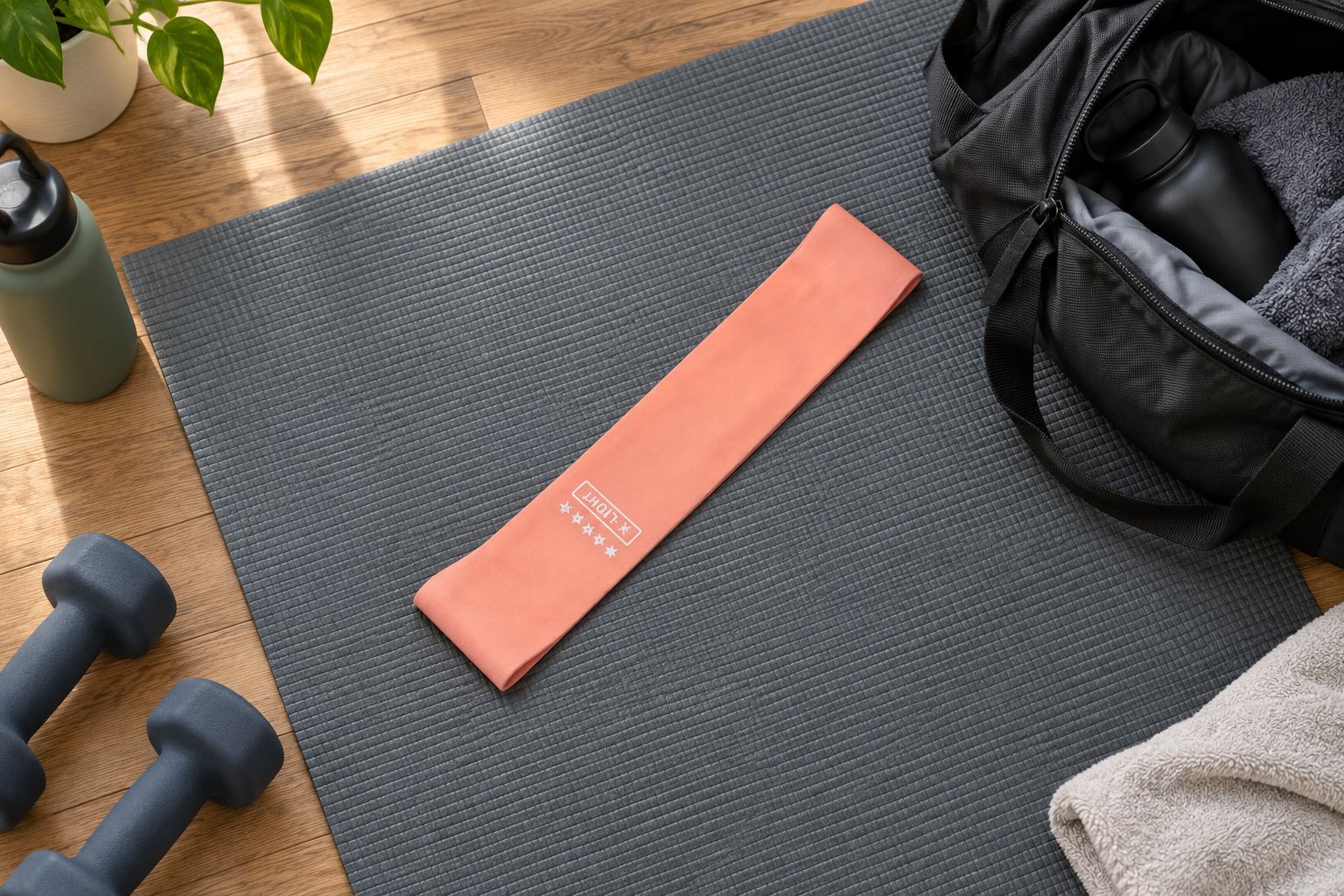
Think about what you already own. An existing exercise mat or suitable carrying bag does not need replacing just to match the bands. Buy the missing function, not an entire new setup.
- Current listing: Check the purchase details directly on the product page.
- Missing equipment: Note any required accessories that are not included.
- Useful pieces: Count the items you will actually use in your routine.
- Existing gear: Keep compatible equipment you already own.
- Replacement choice: Check whether you can identify the same material and resistance when replacing a band.
6. Plan a simple first-use routine
You do not need an elaborate program to evaluate whether a set fits your routine. Start with 1 band at a time unless the product instructions explicitly support another configuration. Follow exercise guidance that matches the band's shape and attachment method.
The first decision is whether you can control the movement using the intended technique. If increasing resistance changes the movement into something you cannot perform as instructed, return to a more manageable option. Do not stretch a band farther simply to chase an advertised load.
Keep a short record of the exercise, band used, and setup. This makes your next session easier to repeat and helps you identify which resistance choices are useful. It also gives you better information when choosing another set later.
- Instructions: Read the product guidance before stretching or attaching the band.
- Starting choice: Select a manageable band rather than beginning with the highest level.
- Movement control: Use the intended range and technique instead of forcing more stretch.
- Session notes: Record the exercise, band, and attachment method.
- Condition check: Stop using equipment with visible damage and follow replacement guidance.
Compare beginner resistance band options
Choose by exercise fit first, then compare the product details. The options below describe different equipment formats, not a ranking of brands. The specific listing has documented material and band-count information; the other rows explain what to check when comparing those formats.
| Option | Best for | Useful feature | Key limitation |
|---|---|---|---|
| Athleticsforhealth Resistance Bands Set, 5-Pack | Beginners seeking portable bands for yoga, Pilates, stretching, and strength workouts | Five natural-latex bands with different thicknesses | Supplied description does not specify exact resistance loads or dimensions; unsuitable when you need a latex-free product |
| Short loop bands | Exercises designed for a band around the legs or arms | Closed-loop shape avoids a separate handle for those movements | Short length does not suit every upper-body exercise or attachment setup |
| Long loop or flat bands | Exercises that need more reach between hands, feet, or a permitted attachment point | Longer format supports setups that short loops cannot provide | Grip, length, and attachment suitability still need checking |
| Handled tube kits | Exercises designed around a handle grip | Handles provide a defined place to hold the equipment | Anchor-based movements require compatible attachments and an appropriate setup |
Do not treat the generic formats as interchangeable. A short loop and a handled tube can both add resistance, but their shape changes how you perform the movement. Buy the format shown in the instructions for the exercises you want to learn.
Common mistakes beginners make
Buying the biggest piece count
A large number on the package can include handles, clips, and storage accessories. Count the actual bands and identify their usable resistance levels. A smaller set that fits your exercise list is more relevant than a larger kit filled with pieces you will not use.
Assuming every color means the same resistance
Color systems belong to individual products. Keep the seller's resistance information with your equipment rather than relying on memory from another set. When replacing a band, compare its documented details.
Choosing a set before choosing exercises
This reverses the useful buying order. Name your movements first, then check shape, dimensions, and any attachment requirements. Otherwise, you risk buying a loop pack when your planned routine uses handled tubes.
Ignoring latex and care requirements
Natural latex is an explicit material choice. If you need a latex-free option, require an explicit latex-free description. Also read the care instructions; do not assume that every elastic band can be cleaned or stored the same way.
Treating extra resistance as automatic progress
A harder band is not useful if it prevents you from performing the intended exercise. Keep the movement consistent when deciding whether to change levels. Resistance labels describe equipment, not a guaranteed training result.
FAQ
What's the best resistance bands set for a beginner?
The best beginner resistance bands set matches your planned exercises, offers a manageable starting resistance, and clearly explains its material and included pieces. Choose the band format before comparing pack sizes.
Are five resistance bands enough to start?
A five-band pack is enough only if its shapes and resistance choices fit your exercises. Band count does not establish usable resistance levels, dimensions, or accessory compatibility.
What does Athleticsforhealth's resistance bands set include?
Athleticsforhealth's Resistance Bands Set, 5-Pack lists five portable natural-latex bands with different thicknesses. The supplied description names yoga, Pilates, stretching, and strength workouts but does not specify exact resistance loads or dimensions.
Are loop bands better than bands with handles?
Loop bands and handled bands serve different exercise setups, so neither is better for every beginner. Choose loops for movements designed around a loop and handled tubes for movements designed around a handle grip.
Do I need a door anchor for resistance bands?
You need a door anchor only for exercises that require that attachment method. Confirm compatibility, included accessories, and setup instructions rather than improvising an attachment point.
How do I choose an affordable resistance bands set?
Choose an affordable set by comparing its current listing with the equipment your routine actually requires. Account for any separately required accessories and avoid buying extra pieces solely to increase the kit size.
Can I tell resistance strength from band color?
Band color is not a universal resistance scale. Use the resistance information for the specific product and check whether any stated load includes measurement conditions.
What should I check before using resistance bands?
Check the product instructions, band condition, and any attachments before use. Follow the permitted setup and stop using equipment with visible damage.
One last thing
Check the lightest band before the heaviest one. Your starting option determines whether the set fits the movements you want to learn; the top resistance label does not answer that question.
Before buying an Athleticsforhealth resistance bands set in 2026, write down the exercise, required band shape, and starting resistance information you need. If the listing cannot answer those questions, ask for the details before adding more equipment to your routine.